The Vacant Showroom: Behind the Mattress Store Conspiracy
Massive, empty mattress stores fuel money laundering rumors. This investigation exposes the cold economic mechanics driving this urban anomaly.
Author Harry
Read 3 Min
Published
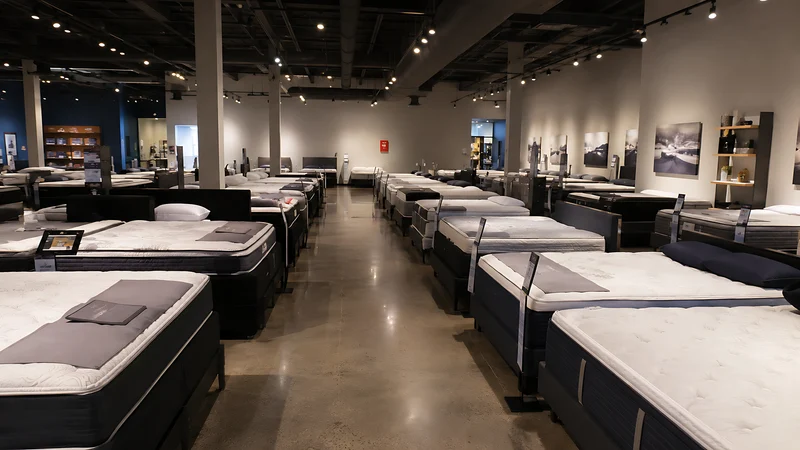
A mattress showroom with rows of beds
The Strange Proliferation of Vacant Stores
The street is quiet. Behind massive glass panes, dozens of white beds align under bright lights. No customers appear. A lone uniformed employee stares at a smartphone behind the counter. Driving through the intersection, another mattress store appears, identical to the first. It is equally vacant.
This scene repeats across major cities worldwide. Despite zero foot traffic, these stores occupy prime real estate spanning thousands of square feet. Standard laws of supply and demand fail to explain these spaces. To some, the repetition suggests a glitch in the system. Others suspect illicit activity. How do massive, customerless storefronts survive indefinitely without facing bankruptcy? This simple question ignited a global conspiracy theory across online forums.
When a store prospers without buyers, perhaps product is not what it sells.
An Anomaly in Modern Commerce
The popular conspiracy theory relies on a seemingly logical premise: global mattress chains serve as fronts for money laundering operations.
Proponents argue criminal organizations use these stores to convert illicit cash into clean revenue. High unit prices mean a few fabricated transactions on the ledger can launder significant sums. The proximity of identical stores facing each other across a single street lends credibility to this theory. No rational business would approve such overlapping locations. The narrative quickly spread from internet boards to mainstream media, cementing itself as a prominent twenty-first-century urban legend.
Yet, examining the actual financial ledgers strips away the cinematic mystery, revealing a cold documentary of capitalist efficiency.
The Illusion of Profit Margins
The mystery unravels once you analyze the business model. Mattresses carry extraordinarily high profit margins. Gross margins typically range from 40 to 50 percent, climbing even higher for private label products.
Unlike restaurants or cafes, these businesses do not require high volume. A single high-ticket sale every few days generates enough revenue to cover monthly rent and payroll, leaving a comfortable surplus. Consumers purchase mattresses once a decade on average. The empty showroom is not a sign of failure but a feature of the design. The business is engineered to thrive on low transaction volume.
A Real Estate Chess Game to Erase Competitors
The bizarre sight of identical stores facing each other stems from aggressive corporate acquisitions. Major mattress chains spent years absorbing smaller competitors to consolidate market share.
Upon acquiring a competitor and rebranding the storefront, parent companies rarely closed the duplicate location. Maintaining the lease often cost less than paying early termination penalties. More importantly, it secured the real estate. Leaving a prime corner vacant would invite new market entrants. The facing storefronts are not money laundering fronts. They represent a ruthless territorial defense designed to lock out competition.
The Ghost Showroom
Minimal overhead supports these expansive spaces. Though dozens of beds fill the showroom, they are merely display models, not retail inventory.
When a customer makes a purchase, the product ships directly from a centralized warehouse to their residence. The storefront requires no storage space or complex inventory management. Staffing is minimal, often consisting of one or two commission-based sales representatives. There are no perishable goods to manage and no need for frequent, expensive interior updates. Despite the grand exterior, these showrooms operate as low-cost shells.
Beyond the Display Window
The conspiracy theories surrounding empty mattress stores stem from an optical illusion: a mismatch between human intuition and capitalist optimization. We assume a store must bustle with activity to survive. Yet capital evolves into increasingly abstract and efficient forms.
There are no illicit ledgers or flows of black money. Only calculated profit maximization and predatory market defense fill the quiet rooms. Stripping away the conspiracy reveals something more unsettling than crime. It exposes the cold survival mechanics operating quietly behind the everyday storefronts we pass without a second thought.
The most effective disguise is the logic of capital hiding behind an ordinary window.
Share