This Man: The Uninvited Guest in Your Dreams
An inquiry into the 'This Man' urban legend, exploring the anomalies of the phenomenon and the reality behind the mysterious dream figure.
Author Harry
Read 2 Min
Published
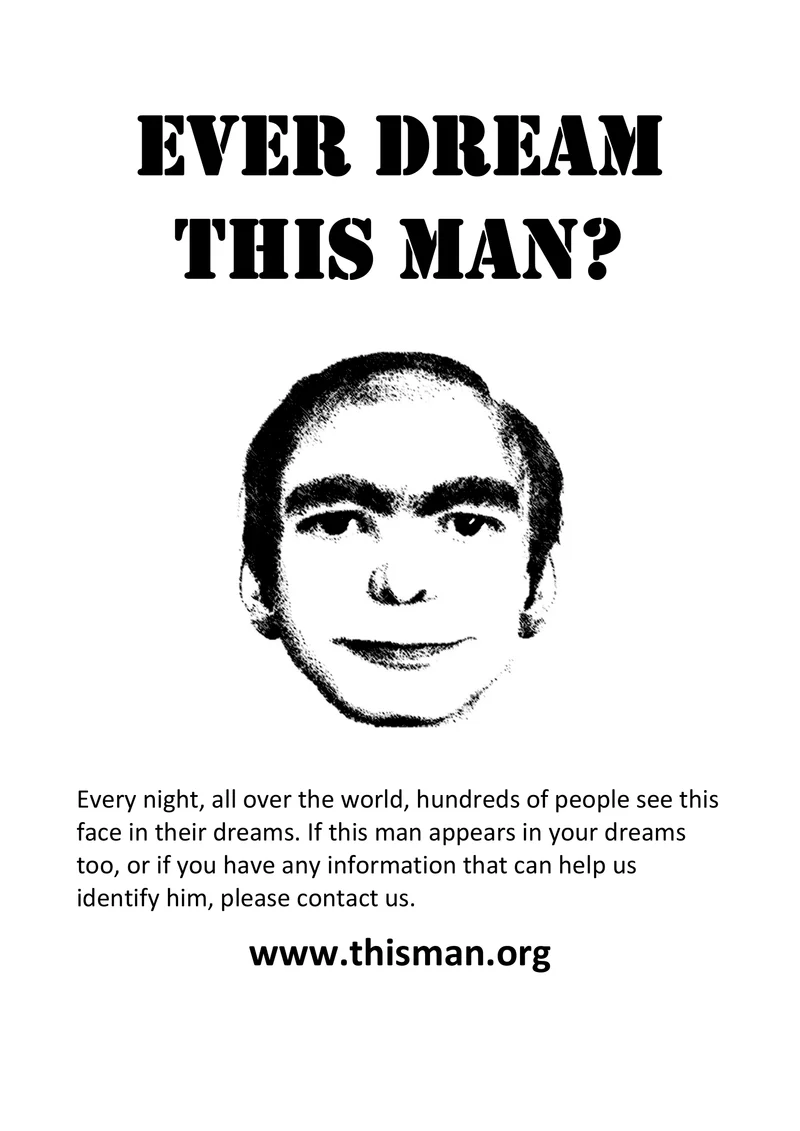
Poster to find "This Man". Photo by thisman.org
The Genesis of Deja Vu
You wake in a cold sweat. The narrative of the dream has already dissolved, yet a single image remains etched onto your retina. A man with thinning hair, thick eyebrows, and unnaturally thin lips. You sketch the face from memory. Driven by unease, you visit a psychiatrist. The physician stares at your drawing, motionless. A few days prior, another patient left the identical sketch, reporting the exact same visitor. Perfect strangers were encountering the same intruder in the depths of their sleep.
We dream in isolation, yet we face the same stranger.
Have You Seen This Man?
The public narrative of This Man begins in New York in 2006. A patient sketched a face that haunted her recurring dreams, leaving the drawing on her psychiatrist’s desk. Days later, another patient recognized the portrait, claiming the same figure frequented their sleep. The psychiatrist shared the sketch with colleagues. Soon, reports surfaced far beyond New York. The subject became known simply as This Man. By 2009, a dedicated website emerged to collect testimonies, turning a localized oddity into a global phenomenon.
Sovereignty Over the Unconscious
Once the portal opened, thousands of accounts poured in from London, Rome, Tokyo, and Seoul. The visitor’s behavior varied. To some, he was a quiet guide offering directions. To others, a persistent stalker. Some reported romantic encounters. Theories proliferated. Carl Jung’s framework suggested an archetype from the collective unconscious. Others posited a dream traveler, or a government mind-control experiment designed to implant imagery. The sheer volume of consistent testimonies lent these speculations a fragile credibility.
A Calculated Illusion
Truth leaves a trail. Skeptics, noting the absence of physical evidence, examined the domain registry. The destination was not a medical facility in New York, but a server belonging to an Italian agency called Guerrilla Marketing. At the center of the web sat Andrea Natella, a sociologist and marketing strategist. The psychiatrist, the clinic, and the female patient were entirely fictitious. Even the sketch was not a product of psychological synthesis, but a modified photograph of Natella’s father as a child. Natella built the site and planted several fabricated testimonies. Public suggestion and digital velocity did the rest. Readers, exposed to the face, convinced themselves they had seen him, while others fabricated memories to participate in the global event.
The Era of Fabricated Memory
The This Man phenomenon concluded as a calculated hoax, a marketing project. The nocturnal intruder did not exist. Yet, the resolution leaves a cold reality. It proved that a single sketch paired with a plausible narrative can manipulate the subconscious of thousands. Human memory is fragile. In an era where algorithms distribute synthetic realities daily, we likely encounter new iterations of This Man every day. Of the memories you hold true, how many are actually yours?
A seamless illusion is a lie completed by the public.
Source
Share