Jules Verne: Prophecy or Calculation?
An analysis of the alignment between 19th-century text and modern science. Beyond mere imagination, we examine Verne's vast data collection and the rational questions left in its wake.
Author Harry
Read 4 Min
Published
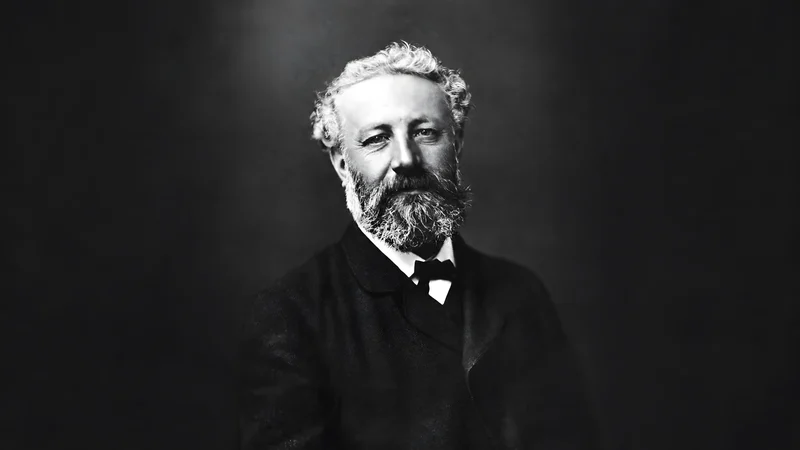
Photograph of Jules Verne
Countdown in 1865
In December 1968, Apollo 8 launched toward the Moon. The launch site was Florida. The crew numbered three. The spacecraft weighed approximately 32,390 pounds. Upon completing their mission, the astronauts deployed parachutes and splashed down in the Pacific Ocean. Every step was the result of precise modern aerospace engineering.
Yet, this mathematical blueprint had been drawn a century prior. A novel published in 1865 recorded the flight trajectory and physical parameters in precise detail. The margin of error was negligible. The author was Jules Verne.
The Official Portrait
Jules Verne remains the pioneer of science fiction. Works like Twenty Thousand Leagues Under the Sea and From the Earth to the Moon are celebrated for their visionary imagination. Official literary and scientific histories categorize him as an intellectual who absorbed contemporary scientific knowledge to construct logical extrapolations. He was a brilliant writer and an obsessive researcher. This is the conventional portrait taught in textbooks.
Patterns Beyond Margin of Error
Yet an anomaly persists. His precision exceeds what extensive reading and academic correspondence can explain. Fantasy differs from prediction. Fantasy is formless; prediction is a coordinate on a blueprint. The technical specifications and physical figures in Verne's novels function less as literary metaphors and more as engineering data.
Electric submarines, helicopters, video calls. The inventions he described eventually materialized. Repeated coincidence becomes a pattern; when a pattern defies statistical probability, it suggests intent. Was he merely an intuitive novelist? Or was he a calculator, much like a modern data analyst, assembling fragmented information to derive precise future outcomes?
Imagination generates coincidence; precise coordinates and physical dimensions bypass chance.
Evidence of Calculation, Not Prophecy
The Original Blueprint of the Apollo Program
The similarities between the spacecraft Columbiad in From the Earth to the Moon and Apollo 8 constitute a statistical anomaly. Verne selected Florida as the launch site. His physics dictated that proximity to the equator was essential to utilize Earth's rotational speed for escape velocity. NASA used the exact same logic when establishing the Kennedy Space Center in Florida.
The coldest facts lie in the dimensions and orbital mechanics. The fictional Columbiad was a conical capsule, 3.65 meters high and weighing 19,250 pounds. The actual Apollo 8 command module stood 3.23 meters high and weighed 26,275 pounds. Both carried a crew of three. Even the method of return, surviving atmospheric reentry to splash down in the Pacific Ocean, was identical. Records show Verne consulted his cousin Henri Garcet, a mathematician, for orbital calculations. Yet, utilizing the limited physics of the 1860s to calculate an escape velocity of 11 kilometers per second and to map lunar gravitational entry with such precision suggests a process far deeper than casual consultation.
A Predictive Model Sealed for 130 Years
Written in 1863, Paris in the Twentieth Century remains Verne's most controversial text. His publisher rejected the manuscript as too pessimistic and unrealistic. Locked in a safe, it remained obscured until his great-grandson discovered it in 1989.
The text, sealed for over a century, coolly depicts the landscape of a 1960s megalopolis: gasoline-powered vehicles, document transmission devices, glass skyscrapers, and a global telegraph network. Verne detailed a system where information traveled instantly across invisible lines, processing complex financial data in real time. This was an accurate early model of modern global telecommunications and financial networks. Perhaps the publisher rejected the manuscript not for lack of literary merit, but because it resembled a technical report far exceeding the cognitive horizon of the era.
A Database Reduced to Ash
The trail of rational doubt leads to Verne's data gathering and his behavior late in life. He built a vast database, systematically clipping scientific journals, academic papers, and newspapers from around the world. He reverse-engineered the trajectory of technological advancement, a method mirroring modern predictive modeling. In this light, he was less a prophet and more a highly disciplined intelligence analyst.
The tension peaks at the end of his life. In 1905, days before his death in Amiens, Verne burned his personal notebooks, unpublished manuscripts, and his entire lifelong archive of research material in his fireplace. The volume of ash was immense. This was a man who mapped human technological progress with precision. Why did he systematically erase his own research trail at the end of his life? What was written on those ashes?
Silence of the One Who Reverse-Engineered Time
From a modern scientific perspective, Verne's accuracy is the product of meticulous research and rigorous analytical power. To claim he was a time traveler or possessed supernatural foresight diminishes his genuine intellectual achievement.
Yet, calculating orbital mechanics and blueprinting a global telecommunications network a century in advance from an 1860s writing desk commands quiet astonishment. Systematically accumulated information becomes a mirror reflecting the future. Verne possessed a larger, clearer mirror than any of his contemporaries. What the final fragments burned in his fireplace once reflected remains an unresolved mystery.
We live out a chapter of the future drafted on a worn nineteenth-century desk.
Source
Share