The Voynich Manuscript: The Silence of an Unbroken Cipher
Written 600 years ago in an unknown language, the Voynich manuscript depicts an alien ecosystem. What does this document, baffling to AI, conceal?
Author Harry
Read 4 Min
Published
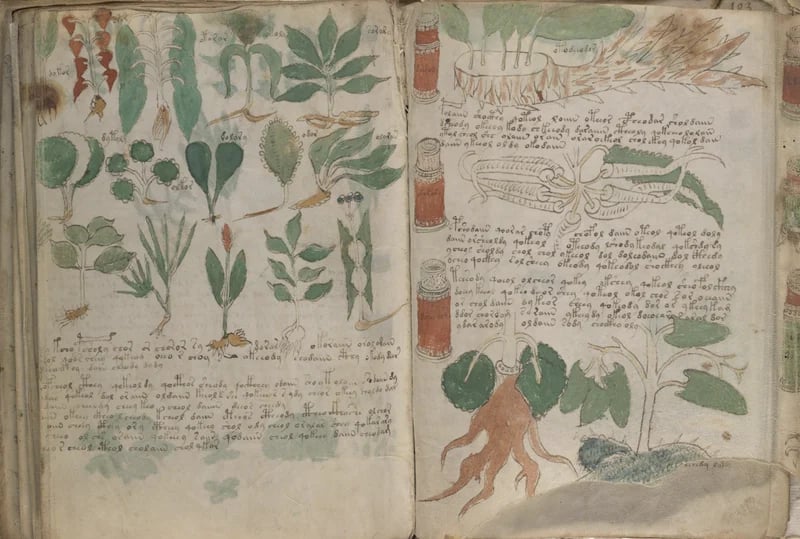
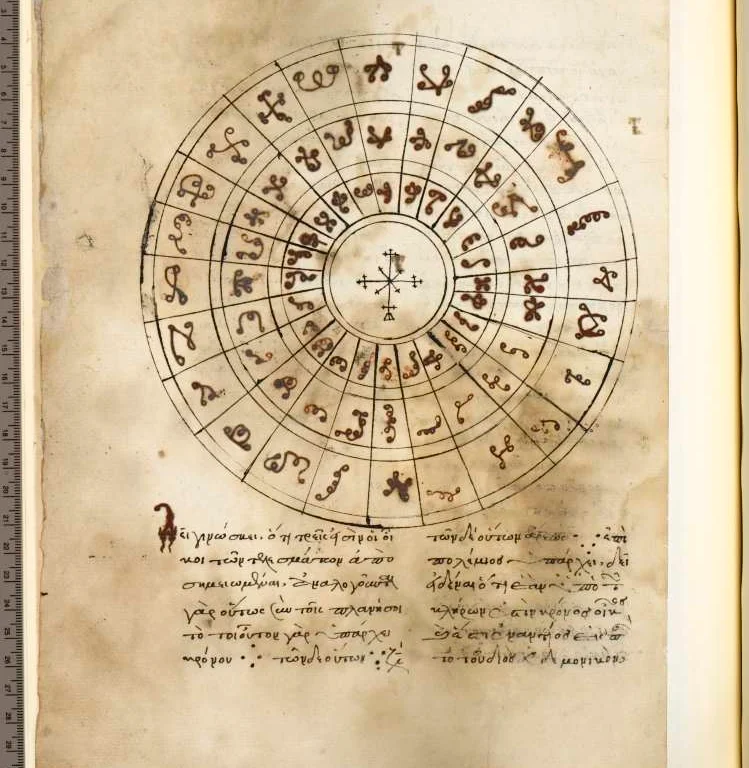
Part of the Voynich manuscript
The Reality of an Unrecorded Language
Deep within the Beinecke Rare Book and Manuscript Library at Yale University, manuscript MS 408 rests inside a climate-controlled vault. To open this volume is to experience an immediate cognitive dissonance. Elegant, fluid script flows across its pages, interspersed with hand-colored botanical drawings, celestial diagrams, and figures engaged in obscure rituals. At first glance, it resembles a conventional medieval herbal or encyclopedia.
Yet, not a single word can be read. The script shares no lineage with any known writing system in human history. While some characters mimic Latin alphabets, the syntax conforms to no existing language family. We know this 240-page codex as the Voynich Manuscript.
Discovery and the Official Timeline
In 1912, antiquarian book dealer Wilfrid Voynich discovered the volume at Villa Mondragone near Rome. Filled with an indecipherable code and lacking any indication of sender or recipient, the manuscript immediately drew academic skepticism. Early theories dismissed it as a modern forgery, a hoax orchestrated by Voynich himself to command a high price.
In 2009, radiocarbon testing by researchers at the University of Arizona settled the debate. The parchment dates back to between 1404 and 1438. Chemical analysis of the ink confirmed it as iron gall ink, a standard medium of the medieval era. The document is authentic. In the early fifteenth century, at the dawn of the Renaissance, someone procured the skins of dozens of calves to produce this volume at immense expense.
The Paradox of Precision
With its authenticity established, the mystery deepened. No medieval scribe would waste such expensive materials on meaningless scribbles. The manuscript had to be either a highly sophisticated cipher or a forgotten tongue. Elite minds tackled the text, from legendary World War II cryptanalyst William Friedman to Cold War-era NSA specialists. Recently, researchers deployed deep-learning artificial intelligence specialized in pattern recognition. All failed.
The most unsettling aspect is not the content, but the execution. The ink shows no hesitation, no corrections, and no erasures. The script flows across the vellum without pause. Translating a complex cipher in real time over two hundred pages without a single error defies human cognitive limits. The scribe wrote with the fluency of a native speaker. This may not be an encrypted code at all.
The pen never wavered. The author thought and breathed in a language lost to us.
An Alien Ecosystem
The botanical section, spanning more than half of the manuscript, elevates the work beyond a mere linguistic puzzle. Over one hundred plant species are rendered in meticulous detail, from leaf veins to complex root structures. Yet, botanists have failed to match a single illustration to any known species on Earth.
Instead, the drawings depict botanical chimeras, such as fern leaves grafted onto lily stems, and roots that morph into reptilian tails. The vessels housing these specimens possess geometric, almost industrial contours that predate medieval design. Whether these images represent extinct flora, alchemical allegories, or a hidden ecological record remains unclear. The illustrations are too consistent and deliberate to be dismissed as products of delusion.
Zipf’s Law and Statistical Traps
What truly confounds linguists is the underlying statistical architecture of the text. If the manuscript were a random sequence of characters, it would lack coherent mathematical patterns. Yet, the writing adheres strictly to Zipf’s law.
This law dictates that in any natural language, the frequency of a word is inversely proportional to its rank in the frequency table. The pattern holds true across English, Latin, and Mandarin. Applying Shannon entropy to the text reveals a level of information density identical to natural human speech. The paradox is clear. Zipf’s law was only formulated in the 1930s. For a fifteenth-century scribe to construct a hoax that mathematically conforms to this law is an impossibility. The structural skeleton of a language is there, yet the meaning remains entirely vacant.
An Anachronistic Vision
The latter sections of the manuscript feature a surreal fusion of astronomy and biology. Intricate astronomical charts resolve into networks of small tubes feeding green fluids into basins where miniature figures bathe.
Viewed through a modern lens, these drawings evoke an uncanny familiarity. The network of tubes resembles human lymphatic vessels or neural pathways. Theorists have speculated that they represent cellular division seen under a microscope, or nebulae observed through a telescope.
Scholars offer a more grounded explanation, suggesting the illustrations represent medieval humorism or alchemical symbols rendered with extreme geometric precision. The author likely sought to link human anatomy with cosmic motion. Whether this reflected heretical belief or the lost knowledge of a secret society remains unknown. What is clear is that the execution is entirely unique, bearing no resemblance to any contemporary work.
The Silent Island of Knowledge
We tend to view human history as a linear progression of progress, believing that what is written will eventually be understood. The Voynich Manuscript quietly refutes this assumption. It exists as a physical artifact of ink and parchment, yet it remains completely vacant of accessible information, a blind spot in human knowledge.
Perhaps this text is not a secret waiting to be decoded, but an isolated domain of knowledge. Six centuries ago, an unknown author documented a world entirely detached from ours. Though modern cryptographers and artificial intelligence continue to press against its boundaries, the parchment remains silent. We are left merely pacing outside a locked door.
The truth is not hidden; we simply lack the grammar to read it.
Source
Share