Hollow Moon Theory: Is the Moon Hollow?
During the 1969 Apollo mission, an impact caused the Moon to vibrate. We examine the hollow moon hypothesis alongside scientific counterarguments.
Author Harry
Read 4 Min
Published
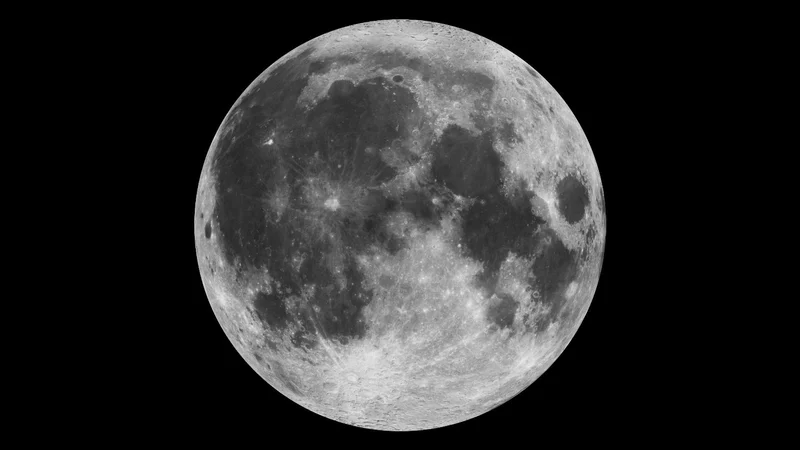
1994 Clementine composite image of the Moon
Resonance in the Void
On November 20, 1969, the Apollo 12 crew prepared to return home. Before ascending to orbit, they jettisoned the lunar module's ascent stage, intentionally crashing it into the surface. The impact yielded the force of one ton of TNT. Passive seismometers placed on the surface registered the tremor. Scientists expected a brief shudder.
The vibration did not stop. It persisted for 55 minutes. The wave peaked and decayed with a signature unknown to terrestrial seismology. The following year, the Apollo 13 third-stage rocket struck the surface with greater force. The seismometers recorded an even longer duration: three hours and twenty minutes. Maurice Ewing, co-director of the seismic experiment, noted that the Moon behaved like a struck church bell. It rang.
An Anomalous Companion
The Moon remains Earth's sole natural satellite. Mainstream astronomy attributes its birth to the Giant Impact Hypothesis: some 4.5 billion years ago, a Mars-sized body named Theia collided with the proto-Earth, leaving debris that coalesced into the Moon.
From Earth, the Moon reveals only one side. Tidal locking keeps its rotation synchronized with its orbit. Despite our nightly view, we can only observe 59 percent of its surface, even accounting for the subtle wobble of libration. Under strict physical laws, science classifies the Moon as a cold, dead sphere of rock.
Anomalies in the Equation
Yet accumulating data reveals cracks in this model. The Moon is abnormally large relative to Earth. The satellites of Jupiter and Saturn are mere dust compared to their hosts. The Moon's diameter, however, is a quarter of Earth's, a ratio unprecedented in our solar system.
Other details invite scrutiny. The Sun is roughly 400 times larger than the Moon, yet it is also 400 times further away. This geometric alignment allows for the precise fit of a total solar eclipse.
The primary anomaly lies in its mass. While Earth's average density is 5.5 grams per cubic centimeter, the Moon's is only 3.3. Given its volume, the Moon is remarkably light. This deficit fuels a persistent alternative hypothesis: the interior is hollow, suggesting the Moon may not be a natural celestial body.
Too large to be a satellite, too light to be solid. What is missing from the Moon?
Three Debates
The Unending Wave
Alternative theories and mainstream science interpret the same data differently. The first debate centers on the seismic paradox.
Proponents of the hollow moon theory argue the resonance proves an empty interior. They suggest a rigid, metallic outer shell, perhaps a titanium alloy, encloses a vast void, causing the structure to reverberate like a tuning fork.
Geologists point instead to dryness and fragmentation. Earth's crust contains water and a pliable mantle, both of which absorb seismic energy. The Moon is bone-dry. Billions of years of meteor impacts have shattered its crust into loose debris. This dry, fractured layer scatters seismic waves, allowing them to travel indefinitely without resistance. The resonance, they argue, reflects texture, not emptiness.
Shallow Craters
The second issue is the depth of lunar craters. Meteorites striking the surface at high velocities should excavate deep pits, typically one-sixth of their diameter.
Yet lunar craters remain exceptionally shallow. Gagarin Crater spans 265 kilometers but descends only 4.8 kilometers. Many craters feature flat or slightly raised floors. In the 1970s, Soviet scientists Mikhail Vasin and Alexander Shcherbakov proposed that an artificial armored hull lies kilometers beneath the dust, absorbing the impacts and preventing deeper penetration.
Mainstream science attributes this to isostatic rebound. During the Moon's early, molten phase, massive impacts ruptured the crust, releasing subsurface lava that flooded the craters and solidified into flat plains. The shallow scars are the result of ancient volcanic activity, not armor.
Mass Anomalies and Gravity Ghosts
The third point is the uneven distribution of mass. While overall density is low, certain areas exhibit high gravitational pull. In 1968, lunar orbiters dipped unexpectedly when passing over the plains known as maria. This led to the discovery of mascons, mass concentrations of high-density material below the surface. A light body with heavy peripheral pockets suggested, to some, an artificial framework supporting heavy machinery under a light shell.
Astrophysics offers a different explanation. In 2012, NASA's GRAIL mission mapped the lunar gravity field. The data showed that mascons formed when iron-rich basaltic lava welled up through impact fractures in the thin crust.
The Moon is light because its core is small, accounting for only 20 percent of its diameter, compared to nearly 50 percent in other rocky bodies.
The Locked View, The Obscured Side
Modern astrophysics and seismic analysis have demonstrated that the Moon is not a hollow construct. The probability of an empty interior approaches zero. No practicing astronomer takes the hollow moon theory seriously today.
Yet facts do not entirely erase the unease of looking at the night sky. The ratio of the Moon's size to Earth, the alignment with the Sun, the unusually small core. If all of which are merely the remnants of a blind collision 4.5 billion years ago, cosmic probability remains unsettlingly precise.
Bound to Earth, we watch only the side the Moon allows us to see. The resonance of that metallic ring from decades ago may have subsided physically, but it continues to vibrate in our imagination.
The Moon remains silent, wearing a face of mathematics, keeping its secrets.
Source
Share