The Thing: A Hollow Piece of Wood Passed from Moscow
In 1945, Soviet Pioneers gifted a wooden carving to the US Ambassador. Inside was a battery-free bug that intercepted secrets for 7 years.
Author Harry
Read 3 Min
Published
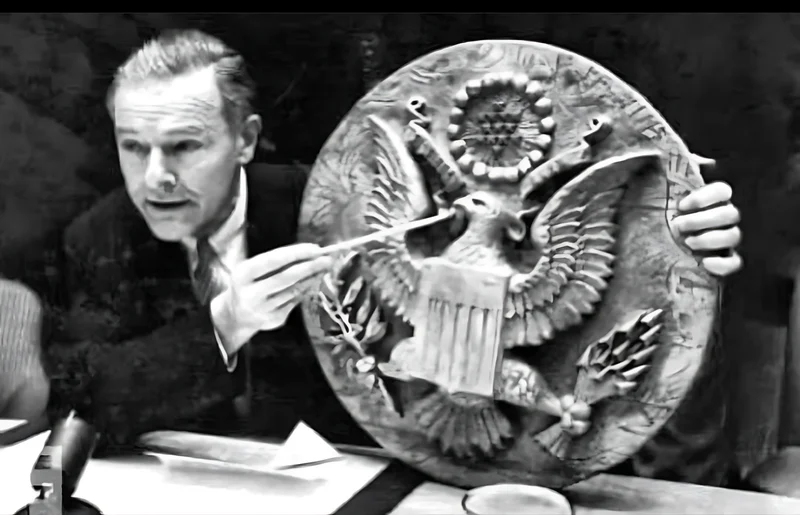
US Ambassador exposing the Soviet Great Seal spy bug in 1960
The Innocent Trojan Horse
August 4, 1945. Moscow, in the final weeks of World War II. US Ambassador Averell Harriman welcomed a group of Soviet Pioneers to Spaso House, the ambassadorial residence. To celebrate the wartime alliance, the children presented a finely carved wooden replica of the Great Seal of the United States. Touched by the gesture, Harriman had the seal swept for security and hung it on his study wall, directly behind his desk.
The study served as a sanctuary for classified discussions. While Harriman believed he had displayed a symbol of friendship, he had installed a Trojan horse in his most private room. Soviet intelligence waited for this exact moment.
An Impossible Technology
As the Cold War intensified, classified information from the embassy leaked systematically. Security sweeps became routine. Technicians tore open walls, lifted floorboards, and disassembled electronics. They found nothing.
Traditional surveillance devices of the era carried two structural flaws. They required batteries for power and transmitters to send audio signals. Batteries degraded; transmitters emitted detectable radio waves. The study at Spaso House remained silent. No signals escaped; no power source existed. By the laws of contemporary physics, the room was secure.
The architect of this impossibility was Lev Termen, the physicist who invented the Theremin. Imprisoned in a secret Soviet laboratory, Termen designed a device that bypassed conventional engineering. It required no internal power.
The Passive Resonator
The design was sparse. Inside the cavity sat a thin membrane and a small antenna. No wires, no batteries. Left alone, the object remained inert. It activated only when Soviet operators parked outside the residence beamed a specific microwave frequency toward the study.
When the ambassador spoke, his voice vibrated the membrane. The incoming microwave signal bounced off this moving membrane, modulating the wave before reflecting it back. Soviet operators intercepted the returned signal and decoded the audio. Without the external beam, the device reverted to a lifeless piece of metal, invisible to detectors. Without a power source, its lifespan was indefinite.
Breaking the Silence
Seven years of surveillance ended by chance. In 1952, a British military radio operator monitoring Soviet air force transmissions intercepted a signal. The voice spoke clear American English. It belonged to George Kennan, the new US Ambassador, speaking inside Spaso House.
Security officials searched the study, scanning the walls until they detected a faint signal near the Great Seal. They pried the carving open. Inside lay a hollow metallic cylinder with a thin wire antenna. Devoid of power or wiring, the object baffled the technicians. For seven years, classified conversations and presidential reports had traveled through this hollow cylinder.
The Thing
US intelligence named the device The Thing. It was a profound technological humiliation. It took years for American and British scientists to reverse-engineer the mechanism. The Thing represents the origin of modern surveillance, an early precursor to Radio Frequency Identification. The technology now used in everyday wireless tags had been perfected and planted in 1945. In 1960, after the Soviet Union accused the US of espionage during the U-2 incident, Washington presented the carved seal to the UN Security Council, a silent admission of mutual surveillance.
The most effective spy makes no sound.
Source
Share