The Simulation Hypothesis: A Flaw in Reality, or Meticulous Code?
From cosmic limits to error-correcting codes in physics, observations suggest our universe may be a simulation. Are we living in base reality?
Author Harry
Read 4 Min
Published
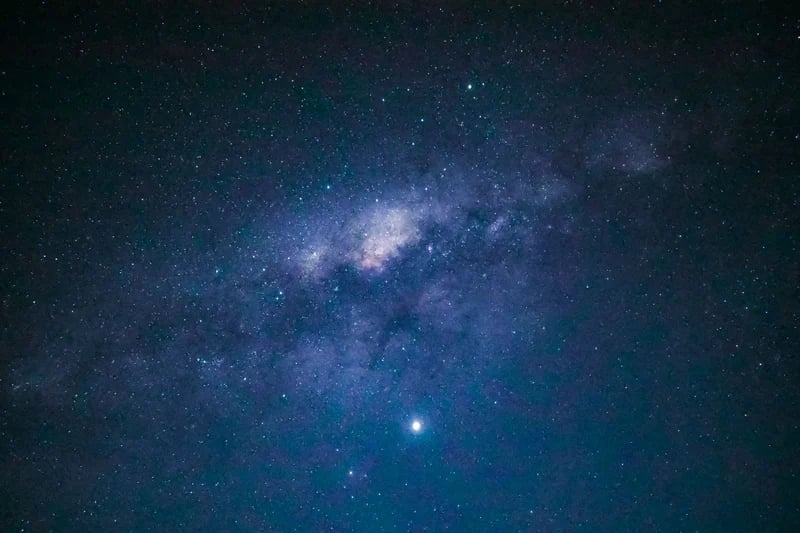
The Milky Way stretching across the night sky. Photo by Nicole Avagliano
The Rendering Limits of the Universe
When we look at the stars, we look at the past. It is a consequence of the physical time light requires to traverse the vastness of space. But adjust the lens. What if this universe is a colossal computer?
The speed of light, approximately 300,000 kilometers per second, may be nothing more than the maximum processing speed of our system, representing a strict hardware limit. The Planck length, the smallest measurable unit of space, corresponds to the minimum pixel of a digital display. Absolute zero, the point at which all thermal motion and information processing cease, mirrors a system shutdown. Every fundamental physical limit aligns like a hard-coded threshold set by a programmer.
Statistics Turned Philosophy
In 2003, Oxford philosopher Nick Bostrom published a brief, clinical paper titled, 'Are You Living in a Computer Simulation?'
Bostrom’s premise is a dry, analytical exercise in probability. Assume humanity avoids extinction and eventually transitions into a highly advanced, post-human civilization. Armed with astronomical computing power, these future descendants would run billions of virtual universes mimicking the lives of their ancestors. Statistically, the probability that we belong to the singular, biological base reality is infinitesimally small. We are far more likely to exist as simulated entities within one of those billions of virtual worlds.
The reason tech pioneers like Elon Musk and astrophysicists like Neil deGrasse Tyson align with this hypothesis is simple. This is not science fiction. It is a formal probabilistic theory discussed at the highest levels of modern academia.
A Fracture in the Foundation of Reality
Until recently, this could be dismissed as a clever thought experiment, a form of modern metaphysics with no empirical backing. But a strange shift is underway. As physics advances, empirical observations increasingly support this philosophical speculation.
In the 1990s, physicist John Archibald Wheeler proposed the concept of "It from Bit," the idea that the fundamental fabric of the universe is not matter or energy, but binary information: yes or no, one or zero. Following this, Gerard 't Hooft and Leonard Susskind mathematically formulated the Holographic Principle. Their model suggests that our three-dimensional reality is merely a projection of information stored on a distant, two-dimensional boundary.
A hypothesis meant for philosophy now aligns uncannily with the laws of physics. As telescopes peer into the deep cosmos and particle accelerators smash atoms, the bedrock of reality reveals not dust and fire, but data and code. A fracture is opening at the foundation of the world.
The deeper we look into the universe, the more we find not matter, but the traces of binary code.
Three Pillars Pointing Behind the Curtain of Reality
Computational Optimization and the Observer Effect
The double-slit experiment in quantum mechanics demonstrates that a particle lacks a fixed position until it is observed, existing only as a wave of probability. Only when a measurement device observes the particle does it collapse from a wave into a physical state. This lack of an objective reality prior to measurement remains one of physics' deepest enigmas.
Viewed through the lens of computer graphics, however, this mystery resolves into an elegant optimization formula. To conserve hardware resources, a 3D game engine does not render environments or objects outside the player’s field of view. Unseen spaces exist only as latent mathematical variables. The moment the player turns, the graphics card renders the scene. Developers call this lazy evaluation, or occlusion culling.
If the universe is a simulation, the observer effect is not a mystical paradox. It is a resource-saving protocol. The cosmos avoids the computational burden of calculating the position and state of every single particle at all times. Instead, it renders matter only when a conscious observer interacts with it. This on-demand rendering keeps the system's processing load to a minimum, perhaps explaining why a universe so vast does not crash.
Error-Correcting Codes in the Equations of Nature
Theoretical physicist James Gates Jr., an authority on superstring theory, discovered a startling mathematical anomaly while studying the fundamental equations of the cosmos.
He analyzed the structure of Adinkras, which are mathematical symbols representing supersymmetry. Within their algebraic structure, he found something unexpected: the exact mathematical symmetry of block linear error-correcting codes, developed by information theorist Claude Shannon in the 1940s. This very algorithm allows modern web browsers and digital communications to self-correct transmission errors.
It is too precise to dismiss as mere coincidence or metaphor. The mathematical language describing our universe contains the same algebraic structure used to prevent digital data corruption. Is it a stretch to view this as a systemic firewall, designed to protect the simulation from runtime errors and cosmic decay?
The Fine-Tuning of Cosmic Parameters
Physicists refer to our universe as "fine-tuned," observing that it is unnervingly hospitable to life.
Astrophysicist Martin Rees identified just six dimensionless numbers that govern the cosmos. These constants, including the strength of gravity and the cosmological constant, are calibrated to an impossible degree of precision. For instance, the cosmological constant, which drives cosmic expansion, is suppressed to roughly 120 decimal places (10^-120) compared to its theoretical expectation. Had this value fluctuated by even a fraction, the universe would have either torn itself apart before stars could form or collapsed immediately into a singularity.
The probability of these constants aligning by pure chance is practically zero. Short of assuming someone typed these initial variables into a compiler with absolute intent, how do we explain this precarious equilibrium?
What Awaits at the Edge of the System
Physicists continue to probe the Planck scale, searching for the fundamental pixels of space. If this universe is data running on a processor, even the most meticulous system must contain glitches or rendering lag. To find these systemic bugs, we run massive particle colliders and send the James Webb Space Telescope to the edge of the observable universe.
But a fundamental question remains: What happens if we succeed? If we map the boundaries of the system and prove, beyond doubt, that this reality is a rendered space, what comes next?
When entities within a virtual environment begin inspecting their own source code and discover they are simulated, how does the system administrator react to this security breach? Perhaps the response is already programmed.
A system reboot.
I am computed, therefore I am.
Source
Share