Junk DNA: The Ninety-Eight Percent Void
Human genome contains 98% non-coding DNA, called junk DNA. Is it a meaningless evolutionary relic or an un-decoded cipher? The origin of life debate.
Author Harry
Read 3 Min
Published
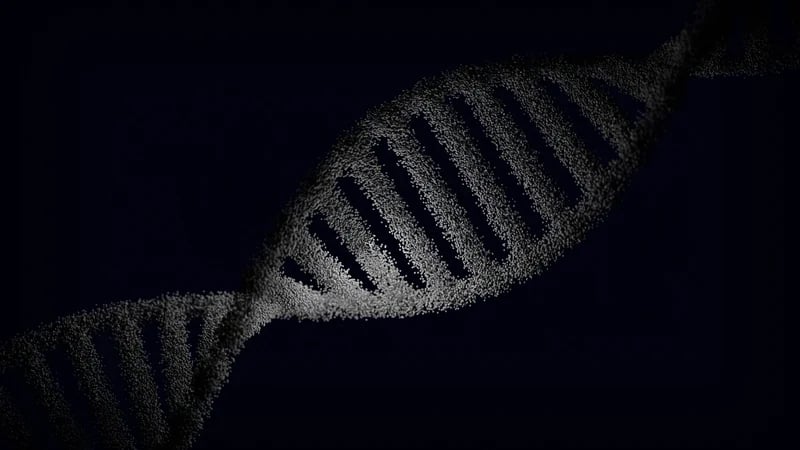
DNA double helix composed of small particles. Photo by Nicola Narracci
The Open Book, Blank Pages
Imagine a highly sophisticated manual of exactly one hundred pages. It is an absolute guide determining your survival. But upon opening it, you encounter a strange discrepancy. Only two pages contain legible sentences. Randomized letters, endless repetitions, and indecipherable symbols fill the remaining ninety-eight pages. What would you do with these ninety-eight pages? Naturally, you would discard them.
This anomaly is not a mere metaphor. It is the reality of human DNA. Nature operates with extreme efficiency, ruthlessly discarding what is useless for survival. Yet, with every cellular division, the human body expends immense energy to faithfully replicate this vast sequence of apparent nonsense. The biological system tolerates a constant overload simply to preserve silent text. It does so quietly, mechanically.
Biological Dark Matter
Completed in 2003, the Human Genome Project was one of the most ambitious scientific endeavors in history. Researchers believed they had decoded the blueprint of life. Given human complexity, they expected to find at least one hundred thousand genes. The reality was different. Humans possess only about twenty thousand genes, a count barely exceeding that of a roundworm or a fruit fly.
The true anomaly lay in the proportions. Only two percent of the entire genome encodes proteins. The remaining ninety-eight percent is non-coding DNA, producing nothing. Academia gave this vast, silent territory an intuitive yet arrogant name: Junk DNA. It defined ninety-eight percent of our blueprint as biological refuse accumulated over millennia.
The architect of life left endless graffiti on the blueprint.
Selfish Genes and Evolutionary Scars
Geneticist Susumu Ohno coined the term junk DNA in 1972. From an evolutionary perspective, this excess is entirely logical. Evolution is not the work of a perfect designer but the product of random mutation and survival. Richard Dawkins' concept of the selfish gene provides a strong theoretical foundation for this view.
Scientists discovered that a significant portion of junk DNA consists of transposable elements, selfish genetic entities that replicate and insert themselves throughout the genome. They contribute nothing to human survival; they exist solely to propagate themselves. Furthermore, endogenous retroviruses, remnants of ancient viral infections that plagued our ancestors millions of years ago, remain fossilized within our code.
In this view, the genome is not a finely tuned machine. It is a biological wasteland, littered with broken genes, viral debris, and blind replicators. Rather than developing a mechanism to purge this waste, carrying it proved more energy-efficient for survival. Junk DNA is the physical scar of a brutal evolutionary journey.
The Control Room of the Ninety-Eight Percent
In 2012, the scientific community faced a major paradigm shift. The ENCODE project, a massive multinational effort led by the National Human Genome Research Institute, released its findings. Hundreds of scientists concluded that junk DNA was not useless. According to their research, approximately eighty percent of the human genome serves at least one biochemical function.
Non-coding DNA does not produce proteins, but it is far from silent. It acts as millions of molecular switches, regulating gene expression with extreme precision. The control room determining when, where, and how much protein to produce resides within this junk territory. This region also constantly generates various non-coding RNAs that orchestrate complex cellular networks without ever translating into proteins.
While a fruit fly and a human share a similar number of genes, their complexity is incomparable. ENCODE researchers argued that this divergence lies not in the genes themselves, but in the complexity of the regulatory networks governing them. If the two percent of coding genes represent bricks, the remaining ninety-eight percent acts as the blueprint directing where and how to lay them. What was once dismissed as garbage is the biological dark matter that defines human complexity.
Cipher or Void
The debate persists. Evolutionary biologists, including Dan Graur, argue that ENCODE defined function far too broadly. A chemical reaction does not automatically equate to a critical physiological purpose. Nonetheless, the possibility that ninety-eight percent of our genome is not mere clutter has destabilized established genomic paradigms.
Every human cell contains three billion base pairs. Most of this sequence remains in deep silence. Is this vast landscape a collection of obsolete code accumulated through trial and error? Or is it a highly compressed, profound language that modern science cannot yet read? The only certainty is that we still do not understand the true nature of this ninety-eight percent void.
We may not yet possess the knowledge to distinguish waste from code.
Share