Ancient Advanced Civilizations: Are Humans Earth's First Civilization?
Did a pre-human civilization truly leave no trace in Earth's 4.5B-year history? We examine the Silurian hypothesis and technosignatures to question the secrets of a planet that erases its own past.
Author Harry
Read 4 Min
Published
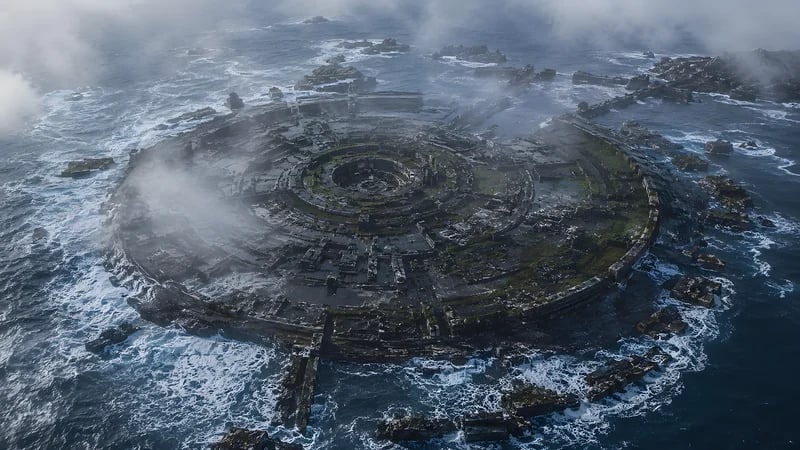
An artist's concept of an ancient, advanced maritime city
Rulers of the Final Two Seconds
Earth is approximately 4.5 billion years old. Compress this vast span into a single 24-hour day, and the era of Homo sapiens, from toolmaking to global civilization, occupies only the final two seconds before midnight. We are taught that the preceding 23 hours, 59 minutes, and 58 seconds were merely a quiet stage for lush jungles, giant reptiles, and single-celled organisms.
Yet this massive temporal void invites a chilling question: during those vast, empty eons before us, did an intelligent species never once rise and build a civilization? Once the domain of fringe theorists, this question has recently entered the realm of rigorous scientific thought experiments.
The Official History in the Crust
Mainstream paleontology and geology are clear: humanity is the sole advanced industrial civilization in Earth’s history. Scientists have mapped a dense evolutionary tree through bones, fossils, and sedimentary layers.
Had a prior civilization existed, it should have left physical markers such as plastics, steel structures, or synthetic radioactive isotopes. Yet across strata billions of years old, not a single fragment of artificial architecture or technological residue has ever been found. The empirical data dictates that history belongs exclusively to us.
The Illusion of Perfect Absence
Yet this absolute absence of evidence harbors a quiet paradox born of the planet's volatile nature. We overlook that Earth is an active erasing machine. Tectonic plates shift, continents collide, and ancient crust plunges into the mantle to melt. Wind, water, and glaciers grind mountains into plains.
On a geological timescale, physical infrastructure is remarkably fragile. Iron rusts into dust within millions of years; glass weathers back into sand. Fossilization itself is so rare that 99 percent of species that ever lived left no physical trace. This geological amnesia creates an absolute blind spot.
Earth is a giant shredder, constantly erasing its own history.
Three Clues in the Dust
The Silurian Hypothesis and the Carbon Paradox
In 2018, Gavin Schmidt of NASA and Adam Frank of the University of Rochester published the Silurian Hypothesis. The paper did not claim a past civilization existed. Instead, it proposed a scientific thought experiment: If an industrial civilization had thrived tens of millions of years ago, what chemical traces would remain for modern geologists to find?
The researchers pointed to the Paleocene-Eocene Thermal Maximum, which occurred roughly 56 million years ago. The clearest marker of an industrial society is the burning of fossil fuels. Plants prefer the lighter carbon-12 isotope during photosynthesis. Consequently, burning massive volumes of coal or oil spikes the ratio of carbon-12 relative to carbon-13 in the atmosphere.
Curiously, sedimentary layers from this thermal maximum reveal a rapid shift in carbon isotope ratios that closely mirrors the signature of modern industrialization. Mainstream science attributes this anomaly to natural events, such as massive volcanic activity or seabed methane release. Furthermore, this warming unfolded over millennia, whereas modern humanity has altered the atmosphere in mere centuries.
Nonetheless, the hypothesis raises a profound point: if a past civilization did exist, its monument would not be a towering ruin, but a microscopic isotopic imbalance in the stone.
The Two-Billion-Year-Old Natural Reactor
In 1972, miners at the Oklo uranium deposit in Gabon, Africa, discovered an anomaly. The concentration of uranium-235 in the mined ore was significantly lower than the natural standard of 0.72 percent. Physically, this indicated that the uranium had already undergone fission.
Fringe theorists claimed it was a nuclear power plant left by an ancient civilization. The scientific explanation, however, revealed a natural wonder. Nuclear fission requires a uranium-235 concentration of about 3 percent. While modern reactors achieve this artificially, back-calculating uranium's half-life reveals that natural uranium 2 billion years ago naturally maintained a 3 percent concentration.
Groundwater seeped into the deposit, acting as a moderator to slow down neutrons and initiate a self-sustaining chain reaction. As the reaction heated up, the water evaporated, halting the fission; once the deposit cooled, water returned, restarting the cycle. By analyzing xenon isotopes trapped in rock pores, scientists proved this natural reactor cycled on and off every three hours for hundreds of thousands of years.
It was entirely natural, yet the fact that the earth operated a nuclear reactor without an architect blurs the boundary of what we define as technology.
Technosignatures and the Anthropocene Stratum
Researchers now refer to our geological epoch as the Anthropocene, studying how human presence will be recorded if we vanish. Smartphones and skyscrapers will not survive. Instead, our legacy will be compressed into a thin, bizarre stratum of microplastics, persistent perfluorinated compounds, plutonium-239 from nuclear tests, and nitrogen fertilizer runoff. Scientists call these markers technosignatures.
The asteroid impact that wiped out the dinosaurs 66 million years ago left a globally uniform band of iridium. Similarly, our global civilization will be compressed into a reddish clay layer mere millimeters thick in 100 million years. Looking back, ancient strata also contain thin bands of anomalous chemical concentrations associated with mass extinctions.
Science attributes these to volcanic eruptions or meteor impacts, but the geological record is a book with most of its pages torn out. To completely rule out undetected technosignatures within those fragmented pages may be a form of geological hubris.
Absence is Not Proof
The objective conclusion is clear: no credible evidence of a pre-human civilization has ever been found. The anomalies that once sparked speculative theories are explained by natural physical laws operating across deep time.
Yet a fundamental tenet of science remains: absence of evidence is not evidence of absence. Kilometers beneath our feet lies a lithosphere closed to human exploration; the vast expanse of the deep ocean floor remains largely unseen. Earth excels at destroying and rewriting its own diary. We may simply be the latest, thinnest coat of paint on a canvas that has been repainted a thousand times over.
Are we the sole heirs of this blue planet, or merely tenants in a room whose history was wiped clean?
Sources
Share