Plague Doctor: The Crow-Masked Doctors
Behind the myth of death's harbingers lies the plague doctor. This seventeenth-century protective suit was born from desperate medicine, worn by historical scapegoats.
Author Harry
Read 3 Min
Published
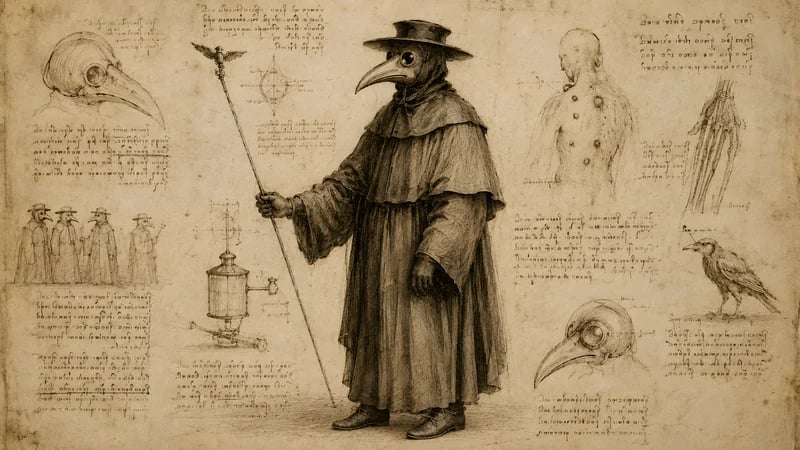
Depiction of a plague doctor
Footsteps on Empty Streets
A dense fog blankets a seventeenth-century European alley. Only decay and silence remain. Then, the rhythmic tapping of a wooden cane echoes against the empty cobblestones. A wide-brimmed black hat, a leather coat falling to the ankles, and a protruding beak. The plague doctor arrives. Behind shuttered windows, survivors watch the silhouette. Where the crow appears, corpses accumulate. To the public, this figure was no longer a healer, but a reaper.
An Icon of Dread
Modern culture consumes this image as a Halloween costume or an occult symbol. Yet, when French physician Charles de Lorme designed the suit in 1619, it represented the height of contemporary medical technology. De Lorme, royal physician to Louis XIII, built the suit on scientific hypotheses, not superstition.
The medicine of his era held that pestilence spread through miasma, toxic, corrupted air that penetrated the skin and respiratory tract. The full-length coat of Moroccan leather was coated in wax and animal fat to block corrupted air and prevent blood or bodily fluids from soaking the fabric. Thick glass domes shielded the eyes. The fifteen-centimeter beak was not a theatrical threat. It was the seventeenth century's first respirator.
The Inversion of Cause and Effect
Historical records are clear. The suit was a defensive mechanism designed for survival. Yet, public perception distorted this utility. Because mountains of corpses appeared wherever the crow mask went, the populace inverted cause and effect. Rumors spread that the doctors carried the curse.
Were they truly dark sorcerers spreading mortality? Administrative records from Italy and France offer a different perspective on this urban myth.
Three Truths Behind the Mask
Theriac and Grim Functionalism
The contents of the beak held the entirety of contemporary pharmacological knowledge. The doctors drilled two small breathing holes at the tip and packed the cavity with aromatic herbs like dried flowers, mint, and camphor. They coated the interior with theriac, an ancient compound of over sixty ingredients, including honey and viper flesh.
The stench of plague-stricken cities defied modern imagination. Believing that putrid air caused the disease, doctors used these aromatics to neutralize the inhalation. The elongated beak was a product of grim functionalism, designed to house these materials while leaving space to breathe. They did not seek to look like monsters; they merely sought to breathe without suffocating.
The Tragedy of Marginalized Labor
When the plague struck, established physicians fled the cities alongside the nobility. Municipal authorities were left to manage the dying. Archival contracts preserved in cities like Pavia, Italy, reveal a sobering truth.
The majority of plague doctors were not elite healers. They were untrained volunteers, destitute laborers, or bankrupt physicians. Municipalities offered them high wages and lodging in exchange for total isolation. They could not speak to citizens or leave designated quarantine zones.
They were not healers curing the sick. Their role was administrative and grim: counting casualties, marking quarantine boundaries, and clearing mountains of corpses. They were expendable labor sent to the front lines of mortality. Many died of the very plague they recorded, their masks failing to protect them.
The Cane of Distancing
The long wooden cane, often white or red, was also misunderstood. The public believed it was a tool for inflicting curses or physical harm. In reality, it was a device for strict seventeenth-century social distancing.
Direct contact meant infection. Instead of touching patients, doctors used the cane to lift clothing and examine swelling lymph nodes, the signature of the plague. They used it to verify deaths on the street and direct body collectors. It served as a pointer for futile treatments, such as bloodletting or applying leeches. When desperate, dying citizens begged for help, the cane served as a physical barrier to keep them at bay. It was not a magical wand, but a fragile barricade built by vulnerable humans attempting to survive absolute ignorance. What was a rational tool of survival appeared to the public as an irrational omen of dread.
Who Made the Monsters?
The plague doctor left one of the most enduring visual legacies in medical history. For centuries, culture consumed this figure as an omen of death or a shadow in dark conspiracies. Yet, administrative archives and early medical texts reveal ordinary humans attempting to survive and fulfill their duties amid absolute ignorance.
They did not create the disease. They merely counted and managed death in locked, abandoned cities. The crow mask was not a threat; it was a fragile shell against an invisible contagion.
Yet, the public remembers them as monsters. Perhaps, in the face of an invisible terror, humanity needed a visible scapegoat on which to project its rage. Was the era defined by a merciless bacterium, or by a desperate public mind that conjured monsters to cope with the unknown?
They did not summon death. They only followed its path.
Source
Share