Four Pests Campaign: An Inconvenient Sparrow
In 1958, a state mandate to slaughter hundreds of millions of sparrows triggered a quiet ecological collapse. This is the anatomy of a massive human attempt to control the biosphere.
Author Harry
Read 3 Min
Published
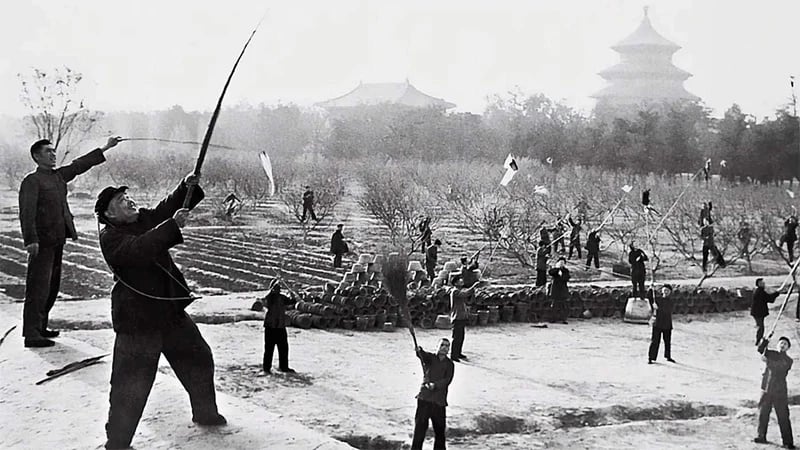
Photo of the Four Pests Campaign for sparrow eradication
The City of Noise
In April 1958, a strange din filled the skies of Beijing. Gongs, pots, buckets, and drums. Millions of citizens flooded the streets, striking every piece of metal they could find. There was no gunfire. Yet the small birds in the sky could not land, forced to circle endlessly. The noise persisted day and night. Eventually, exhausted and overwhelmed by stress, the sparrows began to fall onto the asphalt.
It was a bloodless, mechanical slaughter. Sparrow carcasses piled high in the streets. The crowds cheered. This was not a war. It was a state-sponsored hygiene campaign declared against the natural world.
Eliminate the Four Pests
In the late 1950s, China launched the Great Leap Forward, an ambitious initiative to rapidly modernize agriculture and industry to rival Western powers. During this mobilization, a single metric caught the attention of the leadership: the volume of grain lost to pests and wildlife.
In 1958, the government announced the Four Pests Campaign. The goal was to eradicate four targets that threatened public health and depleted food supplies: rats, flies, mosquitoes, and sparrows. While the first three aligned with standard public health measures, the fourth target presented a fatal flaw.
Humanity had unilaterally removed a variable from nature’s equation.
The Pest and the Silenced Science
The premise was simple. Mao Zedong declared the grain-eating sparrow a pest that robbed the people of their food. Government calculations suggested a single sparrow consumed up to four kilograms of grain annually. The math was direct: killing one million sparrows would save enough food to feed 60,000 people. This simple arithmetic mobilized the public. The sparrow was branded an enemy of the state.
Yet fractures were already forming. Biologists and ornithologists held a different view. Scientists, including the prominent ornithologist Cheng Tso-hsin, opposed the policy using anatomical data from stomach dissections. While sparrows consumed grain during harvest, their diet during the spring and summer breeding seasons consisted primarily of insects, including locusts. The sparrow was not a thief, but a natural regulator of the ecosystem.
These facts were swept away by political slogans. Dissenting scholars were branded reactionaries or enemies of the revolution. Science yielded to ideology, leaving only blind execution. Nests were destroyed, eggs smashed, and hatchlings discarded. Official records estimate that nearly two billion sparrows vanished in a single year. The skies grew quiet. It appeared to be a human victory.
The Deleted Variable
In the spring of 1959, farmers went to the fields expecting a record harvest. The birds were gone. But instead of abundance, they met a dark cloud on the horizon: swarms of hundreds of millions of locusts.
Without natural predators, pest populations grew exponentially. Insects devoured crops at a pace that far exceeded the damage once caused by the sparrows. Not a single leaf or stem remained. Fields, stripped of defenses, were devastated. Chemical interventions failed to match the reproductive rate of the insects. Humanity could not replicate the role of a natural predator. This ecological imbalance, compounded by flawed agricultural policies and severe weather, accelerated toward catastrophe.
The sparrow campaign was not the sole cause of the Great Famine, which claimed tens of millions of lives. The crisis was a complex disaster, born from policy failures, inflated production statistics, and harsh weather. Yet, the ecological disruption served as a critical catalyst, crippling an already fragile food supply. Recognizing the gravity of the situation, the Chinese government quietly accepted scientific counsel in 1960. They removed the sparrow from the target list, replacing it with bedbugs. The campaign ended quietly, without formal admission of error.
The Next Variable
The Four Pests Campaign is not merely a historical footnote. It is cold, empirical data demonstrating how an ecosystem reacts when systemic ignorance meets deliberate intervention.
Consider today. Scientists explore gene-editing to eradicate specific mosquito species, while solar geoengineering proposes spraying aerosols into the stratosphere to block sunlight. We still do not fully understand the complex algorithms of the biosphere, yet we continue to search for the next sparrow to fit our models of control. Nature does not recognize good or evil. It responds strictly to cause and effect. What is the next gear we intend to remove? And what consequences will we face when the void reacts?
Nature does not forgive. It simply delivers the invoice for our errors.
Source
Share