Greek Fire: The Inextinguishable Flame
An ancient weapon capable of burning on water shielded the Byzantine Empire. This analysis examines the historical evidence and scientific hypotheses surrounding this irreplicable secret.
Author Harry
Read 3 Min
Published
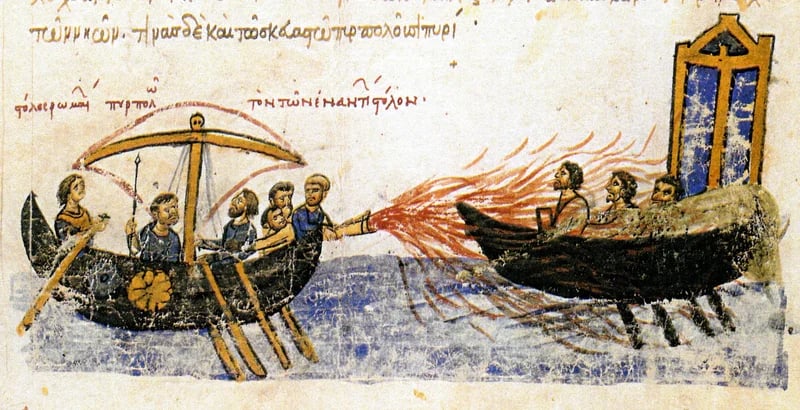
Medieval manuscript illustration of a Byzantine ship using Greek fire
The Burning Sea
Constantinople, 678 AD. A massive Arab fleet filled the horizon. Their sheer numbers made victory seem inevitable. Then, strange bronze tubes emerged from the Byzantine vessels, discharging a viscous liquid. The moment it touched the sea, the water erupted. Water did not extinguish the flames; it fueled them. Soldiers leaped overboard, only to find the surface itself ablaze. The anomalous fire consumed wood, sails, men, and water alike. In moments, the fleet burned to ash, altering the course of history.
Before a flame that fed on water, even the sea offered no refuge.
The State's Absolute Secret
Known as Greek Fire, this substance was the ancient precursor to napalm. Delivered via pressurized tubes, the liquid incendiary dominated naval warfare. Its defining characteristic was its reaction to water, which intensified rather than extinguished the combustion. Historical records state that only sand, vinegar, or aged urine could smother the flame. The Byzantine Empire guarded this formula as its ultimate state secret. Only the emperor and a select handful of technicians possessed the knowledge. Production remained strictly compartmentalized. No single laborer understood the entire chemical ratio or the mechanics of the apparatus. Consequently, when the empire collapsed, the formula vanished.
The Shield of Civilization
Historical accounts credit Kallinikos, a Syrian architect and chemist, with the invention in the seventh century. At the time, the Byzantine Empire faced existential ruin under rapid Islamic expansion. During the massive Umayyad sieges of Constantinople in 678 and 717, Greek Fire alone preserved the capital. The Byzantine navy projected the liquid through bronze pumps called siphons. The pressurized stream erupted with a thunderous roar and heavy smoke. Chroniclers from the Crusades note that enemy soldiers, terrified by the acoustic violence and destructive power of the weapon, fell to their knees in prayer. This technology served as the primary shield that sustained the empire for another eight centuries. Foreign powers dispatched spies to steal the weapon, and some managed to capture samples of the fluid. However, without the complex propulsion machinery and the ignition mechanism, replication proved impossible.
Scientific Reconstruction
Modern researchers have attempted to dissect the chemical composition of the substance using surviving texts. The primary hypothesis points to naphtha, a naturally occurring crude oil from the Black Sea region. Artisans likely blended it with resin to increase viscosity, ensuring the liquid adhered to timber and waves alike. The mechanism of its aquatic ignition remains the central debate. Some scholars suggest quicklime acted as the catalyst. Quicklime reacts violently with water, generating intense heat. A mixture of naphtha and quicklime, projected onto the sea, could ignite spontaneously upon contact. Others argue that sulfur and potassium nitrate were added to elevate the combustion temperature. Yet, modern replication experiments remain incomplete. No recreation has matched the historical accounts of a long-range, pressurized stream operating with acoustic violence. This suggests Greek Fire was not merely a chemical compound, but a complex weapon system integrating mechanical engineering and fluid dynamics.
The Legacy of the Lost Flame
Greek Fire remains a cold testament to ancient technological sophistication. The obsessive secrecy that shielded the empire ultimately erased the weapon itself. Technology dies without documentation. The empire’s most formidable asset now exists only in fragmented texts and legend. The thousand-year-old flame remains undisturbed beneath the currents of history. What we accept as historical truth may simply be a narrative constructed to fill the void of lost fragments.
Absolute secrecy repels the enemy, but ultimately erases the self from history.
Share